|
FROM THE PRESIDENTIAL BIRD FEEDER As of this time, we have had no appreciable snowfall, but the temperatures indicate that it is indeed winter. The winter residents (House Finches, Am. Tree Sparrows, and Dark-eyed Juncos) are now observable during our bird walks. We are waiting for the special winter visitors to show up (owls: Snowy, Long-eared and Short-eared) so that we can start doing winter rambles. Looking at the upcoming events, we will have birding trips on most weekends to give our membership chances to visit birding hotspots that KCA members love. Our trips always provide us with knowledgeable leaders and friendly participants who are more than willing to share their skills with those new to birding. We are changing the location for the January 1st bird walk to Creek Bend Nature Center. This walk is a great way to start your 2015 bird list. After the walk we go Rookies to get dollar burgers. The first Saturday of each month KCA holds it monthly walk around one of the best birding spots in Kane County, Nelson’s Lake. Paul Mayer is leading another ‘distant’ KCA trip, this time to California. Be sure to read about the trip and if you are interested get in touch with him as soon as you can – these trips fill up VERY QUICKLY. At our meetings, we will hear such topics as Bee Keeping, and we will also hear the most recent information about wild mammals in Illinois. One special talk will be about the restoration of the Greater Prairie Chicken in Illinois – it is special because the latest IAS magazine was dedicated to the Prairie Chicken, and also KCA has donated to the project. KCA in conjunction with the St. Charles Park District will hold two activities: the Great Backyard Bird Count on Feb. 14; and on May 16 a bird walk highlighting identification of birds by their song (see ACTIVITIES section in the newsletter for details). Many opportunities are presented for birding and developing friendships with kindred spirits. Come and participate in some/all of them to enhance your birding experience. I was recently hacked and changed my email address (drinibird2@gmail.com), If you don’t get posts from me, please contact me at the new address.
The results of this year Christmas Bird Counts will also be found in the newsletter. Check out the counts to see the winter status of birds in our area. Bob
SURPRISE VISITOR
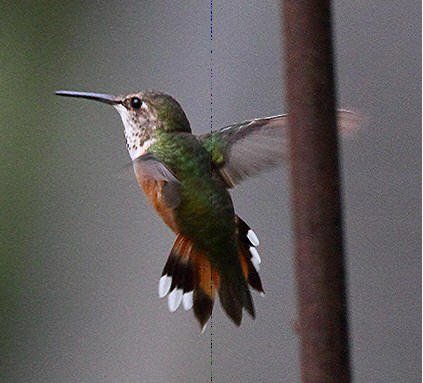
On a late Friday evening (September 12), I happened to look in our backyard and saw a ‘strange’ hummingbird at our feeders. I immediately called my best birding buddy (Kath) and asked for her to take a look. We both exclaimed “Rufous Hummingbird”. I took some pictures, but in the low light the pictures were useful in identifying the bird. The next morning we participated in a KCA bird walk and invited the people to come back to our home to see if the bird was still around. Upon arriving, we saw that the bird was still present - for many this was a life bird. They grouped in our dining room (fresh coffee and treats provided) and OOED and AHHED. The word went out through the electronic media (IBET, and the KCAbirdalert network). By that afternoon 30 birders migrated to our yard to see the bird. The next morning more satisified visitors saw the bird as he dominated the backyard scene chasing Ruby-throats as they tried to feed. For the next two days, the Rufous ruled the backyard and all was good. On the next Wednesday morning, in the spot where the Rufous typically set up his observation post, a newly arrived Ruby-throat Hummingbird had taken charge. The Rufous was seen by one observer early in the morning before it was chased away by the newcomer. That afternoon, in spite of many observers spending a lot of time looking, the Rufous was last seen, very briefly, being persued by the now-dominant Ruby-throat. The debate about it being a possible Allen’s Hummingbird was dismissed by the excellent photograph (seen below) taken by KCA member Gorden Garcia. It was fun while it lasted. In the short 6 days, about 150 birders descended on our yard to share stories and look for the amazing bird. Bob Andrini
Photo by Gordon Garcia
“California or Bust” April 22 to April 30, 2015 Just like last year, close your eyes for just ten seconds and whatever you do, DO NOT think about Yellow-footed Gulls, California Quail, California Condor, Island Scrub-jay, Yellow-billed Magpie, Pacific-slope Flycatcher, Tricolored Blackbird, Lawrence’s Goldfinch, Black-tailed and California Gnatcatchers, Le Conte’s Thrasher, Bell’s Sparrow and countable exotic birds. Go ahead and try. Again, couldn’t do it could you? That says only one thing; you need to seriously consider Kane County Audubon’s “California or Bust” now scheduled for April 2015. The objective of the nine day trip will be to provide a unique birding experience for those who have never birded Southern California, those who need to add western specialties to their life lists, or both. We will start out from San Diego and proceed east to the Salton Sea where we will be looking for California specialties such as Yellow-footed Gull, the newly split Ridgway’s Rail, Black-tailed Gnatcatcher, perhaps a Barn Owl, and a variety of sandpipers, plovers, avocets and waterfowl. We may even be able to scare up a Crissal Thrasher or two. Then it’s up into the mountains where we will start looking for Mountain Quail, Pinyon Jay, White-headed Woodpecker, Red-breasted Sapsucker, Pacific Slope Flycatcher and other mountain species. Next we descend into the Mojave Desert where we expect our first encounters with Lawrence’s Goldfinch as well as LeConte’s Thrasher all the while being watchful for migrating western warblers, raptors and passerines. Then it’s off to a California birding hotspot, the Kern Valley. Here we will be looking, again, for Lawrence’s Goldfinch, Oak Titmouse, Western Tanager and now for the first time, Tricolored Blackbirds. Then after a brief stop in Bakersfield for Spotted Dove and Rose-ringed Parakeet, it’s off to the really high altitudes (8000+ ft. ) in and around the Mt. Pinos area looking for California Condor as well as the high mountain woodpeckers (White-headed, Acorn, Hairy), Pygmy Nuthatch, Clark’s Nutcracker, and Cassin’s Finch. But wait, there’s more! Descending from the high mountain areas, we will proceed through the Carrizo Plain seeking the Yellow-billed Magpie on our way to Ventura. Here we’ll sail out to Prisoners Harbor at Santa Cruz Island going after the endemic Island Scrub-jay as well as a few of the sea birds we’d like to add to the list (e.g. Scripp’s Murrelet and an assortment of auklets , gulls terns and grebes). The last leg of the trip will be down along the Pacific coast where we will seek out such species as Allen’s Hummingbird, Wrentit, California Gnatcatcher, California Thrasher, Scaly-breasted Munia and much, much more. In all we’re hoping to see perhaps fifty or so species not seen on other trips with a total of perhaps 150 +/- species. So, if you’re interested in going, here’s how to get started:
FROM NATURES NOTEBOOK November 01, 2013 "Every morning for the past several days, between 9 and 10 AM, I had seen small flocks of turkeys exit the woods to feed in a cut cornfield. The further most corner of this field comes to a point and is bordered by hardwoods that drop off dramatically to a river on one edge and a creek on the other. Drop off is about 200 feet and is quite steep. The fact that few people attempt to climb this hill and that the trees can be easily used for a roost make it a frequent spot for feeding and roosting turkeys. This Saturday morning I saw the usual variety of songbirds, many within 6 or 7 feet and even nuthatch only inches from my face. This is not unusual for a proper bow hunter. I have had songbirds sit on my nocked arrow, on the bill of my hat and one on my head who pecked me. The necessity to keep perfectly still in order to allow a deer to come into 20 yard range affords us the chance to see many birds up close. Several years ago I shared a small tree with a red tailed hawk- but that’s another story. Turkeys are particularly hard to fool. They can identify the human silhouette from 200 yards, can see you blink at 40 yards and will disappear the moment they identify you. This particular stand is located in an oak triangle of trees large enough to successfully hide me- at least from beyond 50 yards. The turkeys I had been seeing would congregate along the woods/cornfield border and scan the open cornfield for 10-20 minutes before deciding it was safe to feed on the corn left by inefficient harvesting equipment. On this particular morning a half dozen hens and 15-20 of their young came into view from the opposite side from which I was sitting. After a half hour of their feeding and chasing in the cornfield, 5 or 6 big Toms entered the field from the woods on my side. They did not mix with the other flock but stayed fairly close feeding in the same area. After another 10 minutes or so the hens and their young headed toward me. About 30 yards from my stand, they cut into the woods and paraded single file by me. I counted 23 but was sure several more passed by without my noticing. This left the gobblers alone in the field for maybe another 5 or so minutes before a pair of full grown coyotes of slightly different size from one another came busting out of the woods. I assumed it was a mated pair working together to get lunch. I have seen this before: coyotes sneaking along woods edge as turkeys feed in an open field, only to scatter and fly when the coyotes made their move. But this time the gobblers made no effort to retreat. As the coyotes became visible 40-50 yards away, the gobblers flocked together close enough to touch each other. The first coyote charged and the lead turkey jumped and attempted to spur the dog. He only missed by inches. This seemed to confuse the coyote and he retreated a few feet. The turkeys reformed a tight circle I can only assume in anticipation of another attack. But this did not happen. Instead the coyotes turned, put their noses to the ground and resumed pursuit of the smaller, younger, easier prey that had trailed in front of me. With a 5 minute head start I can’t say whether the hens and poults were caught or not, but I didn’t hear any fighting. The gobblers in the cornfield stayed clustered for another minute then ran off in a perpendicular direction to the coyote trail. Dan Pusateri
If you have an item that might be used in “From Natures Notebook”, please get it to me (Bob A)
NEW MEMBERS Here is a list of the newest members to Kane County Audubon. When you see them at a meeting or on a field trip, welcome them and invite them to our activities.
Downers Grove: Russel Locigno
Elgin: Beverly Timm
North Aurora: Marilyn LeVasseur
Oswego: Gary Tollaksen
St. Charles: Anne and Patrick Francissen Stanley Korwin
Wheaton: Paula Brkich _____________________________________________________________________________________________________________________________________________________
TRIPS/RAMBLES
As of this printing, KCA has had 59 field trips or rambles and seen an amazing 268 birds. Field Trips are scheduled events while rambles are ‘spontaneous’ birding events that are announced usually on the Monday of the week through the KCAbirdalert listserve. If you would like to get on the listserve, you must contact Bob Andrini and give him your email address. Each year for the past 3 years KCA has had one long distance birding experience (in 2015 to California) and many of the 268 birds seen in 2014 were seen on this trip. The 2015 KCA year list will begin on our Jan. 1st walk _____________________________________________________________________________________________________________________________________________________
BOB’S NEW EMAIL ADDRESS
Many of you realize that Bob Andrini has been having computer problems. He can now be contacted (and only contacted) at drinibird2@gmail.com. Please make the change, and if you have not been contacted by him recently, you must email him to remain on the KCA lists. _______________________________________________________________________________________________
KESTREL NESTING PROJECT
The leaves are falling and cold weather is upon us yet again. This means one thing: winter is fast approaching. In a few months, 2014 will come to a close, wrapping up the third year of the Kane County Kestrel Nest-Box Program. With that being said, I’d like to share how this past year went. There were high hopes for Kestrels this past spring. With generous donations from you, the Kane County Audubon Chapter and the Veterans Conservation Corps of Chicagoland (VCC), materials for 15 brand new Kestrel nest-boxes were able to be purchased. As if that wasn’t enough, the VCC graciously agreed to build all 15 of the boxes themselves. On top of that, Kane County resident, carpenter, and avid birder John Heneghan also purchased materials and built an additional 5 beautiful Kestrel nest-boxes himself. Sixteen of these newly build boxes were installed at 9 different locations in early spring. The boxes were placed in open habitat near grasslands, hayfields, pastures, and even an organic farm. The new locations included sites around the county such as Peck Farm, Muirhead Forest Preserve, Sauer Family Prairie Kame Forest Preserve, Heritage Prairie Farm, Mooseheart Farm, Corron Farm, Rolling Oaks Farm, Garfield Farm, and the Hickory Knolls Discovery Center. With the installation of all these new boxes, we expected an increase in occupancy rates by Kestrels this year, but what happened was quite the opposite. It was a very disappointing breeding season for the program, with no boxes occupied by Kestrels and very few Kestrel sightings at all throughout the county. In early April, Kestrels were seen hanging out around a few of the boxes. A male Kestrel was spotted several times near a box at Corron Farm and a pair of Kestrels was spotted hunting almost daily near a box at the Aurora West Forest Preserve. The female of the pair at Aurora West was even seen entering and exiting the nest-box, but soon these Kestrels disappeared from the area altogether and Starlings took up residence in the box. It is unknown whether the Kestrels left the nest-box at the Aurora West willingly, or if they abandoned it because of the continued Starling presence which included frequent mobbing and the repeated removal of the wood shavings placed inside the nest-box. After these few encounters in early April, no Kestrels were sighted near any of the nest-boxes for the rest of the spring and summer. On a positive note, 2 of the boxes were occupied by Eastern Bluebird pairs, and 1 box was occupied by Tree Swallows, with all three of these nest-boxes successfully fledging young. I can only speculate as to why this breeding season was so unsuccessful for the Kestrels. We had an extremely harsh winter and an unusually cool spring and summer, which may have played a role. Based on my personal observations, conversations with friends and other birders and local sightings provided online (eBird and the Kane County Audubon website), very few Kestrels were sighted within the county during the entire breeding season. The area’s rodent and insect populations may have taken a hit from the long and harsh winter, and because of this, Kestrels may have moved to other areas with higher prey densities, or may have chosen to forgo any breeding attempts this year at all. Although this was an extremely disappointing year for Kestrels in Kane County, I still have hope that things will turn around next year. I cannot express how thankful I am for your continued support of this project. None of this would be possible if it wasn’t for the help of the Kane County Audubon Chapter. I would like to extend a special thank you to Marion and Rich Miller, Cathy Blecker, John Heneghan, and Scott Fontaine for aiding me in monitoring nest-boxes. You all did a great job this season! There’s no way all the boxes could have been frequently monitored this breeding season without you. Once again, I would like to thank all of Kane County Audubon, the Veterans Conservation Corps of Chicagoland, and John Heneghan for donating money for materials and for building spectacular looking Kestrel boxes. Outstanding job. I hope everyone has a great winter and I look forward to presenting this year’s results from the Kestrel program at the January KCA meeting. Happy Birding Thanks again Taylor Joray ____________________________________________________________________________________________________________________________________________________
GREAT BACKYARD BIRD COUNT
Become a Citizen Scientist by participating in the annual Great Backyard Bird Count. This is a national bird watching event where people across North America (and the world) count birds during a certain period and report the results to Cornell Lab of Ornithology. The 2015 count will take place from Feb. 13 to Feb. 16. Once you have counted the birds, you can submit your data to the Cornell Lab website (www.birdsource.org). If you don’t have a computer, get in touch with me and I’ll post your numbers. KCA will be a Hickory Knolls on Feb. 14th from 12 to 4 PM. We will also lead walks around the Hickory Knolls Natural Area from 2 PM until 3 PM. We need volunteers to help out in hourly segments – let me know if you are available. If you need to learn how to count birds for the GBBC, contact me or go to www.birdsource.org for information. Come and help out with this event – and bring friends (children/grandchildren) with you to help share the experience. In past years, many Kane County citizens have participated – this year get involved, and invite others to help you out. You don’t have to just count birds in your backyard – take a walk: go to a neighbor’s house and help them count birds. You can also turn in lists from different areas on the same date. Bob Andrini
CHRISTMAS BIRD COUNTS - 2014
FERMI CHRISTMAS BIRD COUNT – 2014 – AREA 8 ONLY
This year we had relatively good weather for being so late in December. It was cloudy with highs in the lower thirties and not windy. We had 9 teams out counting with a total of 24 participants. There was no snow cover, so walking was quite a bit easier than the last few years. Some of the deeper lakes in the area still had open water so all of the waterfowl were not concentrated along the rivers and creeks. The birds were pretty good at hiding this year which kept the overall numbers low, but we still managed to get a total of 46 species. Some of the waterfowl sighted include 6 American Black Ducks, a Bufflehead and a Common Merganser. Among the raptors were a couple of Bald Eagles, 5 Northern Harriers, a Rough-Legged Hawk, and our resident Peregrine Falcon in downtown Aurora. Other birds worth noting were 15 Great Horned Owls, a Winter Wren, 95 Cedar Waxwings, and 6 White- Crowned Sparrows. Surprisingly 20 Sandhill Cranes and a Saw Whet Owl were recorded earlier in the week but not on Count Day. Some of the birds we might have expected to see but didn’t were Eastern Bluebird, Carolina Wren, Purple Finch, and Snow Buntings. Thanks to all ofthe Citizen Scientists who braved the elements and helped out his year to make a mark in history. Terry Murray
BIG ROCK CHRISTMAS BIRD COUNT – 2014
On 14 December National Audubon held its’ third annual Big Rock Christmas Bird Count. Twenty-four birders - including 21 Kane County Audubon members – participated. 2014 offered a unique challenge with temperatures in the mid- 40s, no snow, and damp and often foggy conditions. This contrasts with 2013, which saw partly-cloudy skies with temperatures generally below 15 degrees. Big Rock’s eight teams counted 66 species, including: Ross’s Goose, Canvasback and Eurasian Collared Dove. The 66 species compares with 72 seen in 2013. Weather, combined with some uncovered areas may have contributed to this decrease. Here are the results for some general categories: Tim Balassie
___________________________________________________________________________________________________________________________________ PHOTO EXHIBIT
KCA has been invited to display photos at Hickory Knolls Discovery Center from the middle of February until the end of March. If you have photos (maximum of 3) that are mounted and ready for hanging, please contact Bob Andrini. This is a great opportunity to display work of many of the fine photographers that we have in our midst. ______________________________________________________________________________________________________________________________________________________ UPCOMING EVENTS Following are the dates/times/location/leaders for upcoming activities. Trips start at the location listed unless it is for a traveling trip when we will start from the lower parking lot at Hickory Knolls. Please dress for the activity and bring insect spray if needed. All meetings are held at Hickory Knolls Discovery Center. If you have any questions, please contact the leader of the walk or Bob. KCA activities are open to the public.
Jan. 1 Rhonda’s New Years Day Walk: note new location for 2014 Creek Bend Natural Area: 9 AM: Nancy 3 Nelson’s Lake walk: 8 AM: Terry 10 Bird the River: 8 AM (Hickory Knolls): Bob 14 MEETING: Bee Keeping: Jim Feuerborn: 7 PM 24 IAS Bald Eagle Weekend at Starved Rock – individual 31 Fermi Lab Birding: 8 AM: John S. Feb 7 Nelson’s Lake Walk: 8 AM: Terry 11 MEETING: Winter Birding in Illinois: Vern Kleen: 7 PM 14 Gull Frolic: limited number – contact Bob A. 14 Great Backyard Bird Count: Hickory Knolls: 12 PM – 4 PM: Jon 21 Birding County Roads: Hickory Knolls parking lot: 9 AM: Tim 28 Birding Quarry Park, Batavia: 8 AM: Nancy Mar 7 Nelson’s Lake Walk: 8 AM: Terry 11 MEETING: Mammals in Illinois: Jack MacRae: 7 PM 14 Tyler Creek Walk: 8 AM: TBA 22 Burnidge FP Walk: 8 AM: Bill 28 Oakhurst FP Walk: 8 AM: Vernon Ap 4 Nelson’s Lake Walk: 8 AM: Terry 8 MEETING: TBA; 7 PM 11 Waterfowl Trip: meet at east side Fabyan Parking lot; 7 AM: John S. 18 LeRoy Oakes Walk: 8 AM: TBA 22 – 30: California Birding Trip: limited numbers: 25 Bliss Woods Birding: 7:30 AM: Mary O. May 1 – 3: IAS Spring Fling: Springfield 2 Nelson’s Lake Walk: 8 AM: Terry 9 Spring Bird Count: Jon 13 MEETING: Greater Prairie Chicken Restoration: Bob Gillespie: 7 PM 16 Hickory Knolls Walk: 8 AM: TBA 23 Lake Michigan Birding; 5:30 AM: Millers (note time for departure) 30 Hampshire FP: 8 AM: Brendon
LEADERS Bill: 847-931-9123 Bob: 630-584-8386 John S: 630-715-0428 Jon: 630-584-5891 Mary O: 630-466-4922 Millers: 630-450-2997 Nancy: 630-365-9595 Terry: 630-750-6840 Tim: 630-817-0450 ___________________________________________________________________________________________________________________________________
MEETING TOPICS
January 10 - Jim Feuerborn Jim is a local bee keeper in St. Charles that has been involved with bees for many years. He is very knowledgeable and will talk about his trade as well as some of the problems relating to bee populations. Everything you wanted to know about bees. I mean, you know about the birds. Now you will know about the bees.
February 11 - Vern Kleen The slide program will be "A virtual birding day in the Kane County area visiting all birding habitats in the winter". We'll begin searching for owls before dawn, then visit the various habitats at the best time of day to find the maximum number of bird species. During the search we'll concentrate on the winter sparrows. At the end of the program we'll discuss Illinois' other sparrows as well.
March 11 - Jack MacRae, DuPage County Forest Preserve. Through photos and field documentation, Jack MacRae will discuss the influx of large mammals into Illinois. We are talking Black Bear, Mountain Lion and Bobcat to name a few.
April 8 - TBA
May 13 - Bob Gillespie, Prairie Ridge State Natural Area Bob Gillespie will enlighten us about the struggles and victories of trying to reestablish the Greater Prairie-chicken into the Illinois landscape. Bob has been involved in the program since its inception and has firsthand experience in this program. He will have just returned from trapping birds in Kansas and bringing them back to Prairie Ridge. ______________________________________________________________________________________________________________________________________________________________________________
Kane County Audubon – A Chapter of Illinois Audubon |